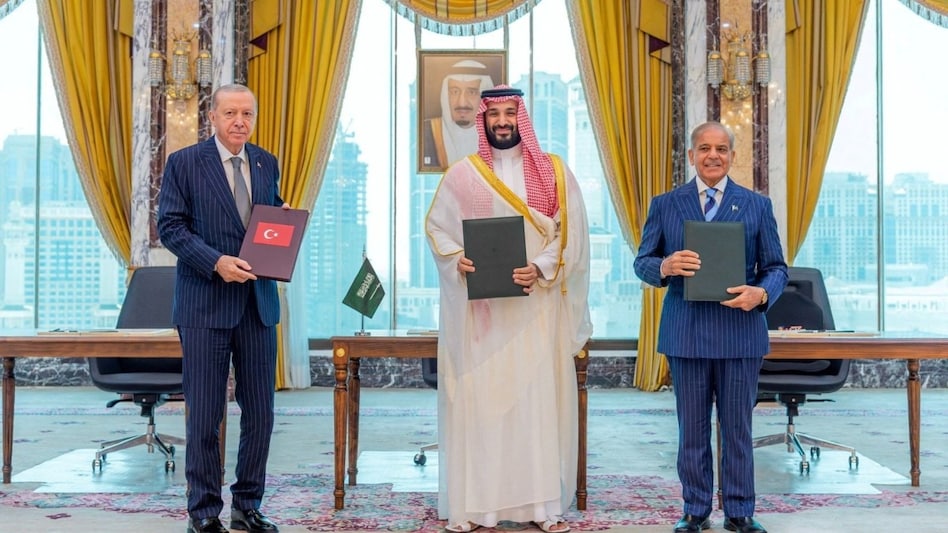
Pakistan, Türkiye and Saudi Arabia have signed a mutual defence agreement, marking a significant development in the changing geopolitical landscape of the Middle East. The agreement was signed on Friday, August 7, and is being referred to as the Mecca Joint Defence Agreement.
The deal comes after a similar agreement was signed between Saudi Arabia and Pakistan last year. The latest agreement has raised questions about the changing balance of power in the Middle East. Experts believe it could potentially mark the beginning of a broader regional partnership involving Pakistan, Türkiye and Saudi Arabia, while remaining cautious about both Israel and Iran.
The three countries have attempted to project unity and collective strength amid growing regional security challenges. However, they have been careful not to present the agreement as an alliance directed against any particular external power.
It is also not yet clear to what extent the agreement would require the other two members to come to the defence of one country if it were attacked.
Pakistan has been involved in a border conflict with Afghanistan since February and also experienced several days of military conflict with India in May 2025. Saudi Arabia has faced repeated attacks from Iran and groups allied with Tehran. Türkiye, meanwhile, has been fighting Kurdish armed groups both inside and outside the country for years, while tensions with Israel have also increased.
However, it remains unclear how the Mecca Joint Defence Agreement would apply if any of these existing conflicts were to escalate.
Major Changes Taking Place in the Middle East
The Middle East has witnessed major geopolitical changes in recent years. The Hamas attack on Israel on October 7, 2023, followed by Israel’s military operations in Gaza, significantly increased instability across the region.
At the same time, decades of tension between Iran and Israel have increasingly transformed into direct regional confrontation. Against this backdrop, several countries are attempting to put old differences aside and explore practical arrangements in response to shared security concerns.
The main objective of the Mecca Joint Defence Agreement is reportedly to strengthen the three countries’ ability to respond to potential threats.
Each country brings a different strategic capability to the proposed framework.
Pakistan contributes an experienced military, defence capabilities and nuclear deterrence.
Türkiye brings advanced drone technology and a strong domestic defence manufacturing industry.
Saudi Arabia, meanwhile, has significant financial and economic resources that could provide the economic foundation for such a security framework.
Why Is There a Growing Demand for New Military Alliances?
The search for new security partnerships has increased amid growing questions about the reliability of the United States as a long-term security partner.
Saudi Arabia and Türkiye have traditionally viewed the US as an important security partner. However, uncertainty surrounding US foreign policy has encouraged some regional countries to explore additional strategic options.
Experts also point to concerns among some US partners regarding Washington’s strong support for Israel and the implications of that policy for regional security.
The emerging Pakistan-Türkiye-Saudi Arabia partnership could therefore become an important development if the three countries succeed in converting their political understanding into meaningful defence cooperation.
Which Other Countries Could Join the Bloc?
There is also speculation about whether other regional countries could eventually become part of this emerging security framework.
Countries such as:
- Egypt
- Qatar
- Syria
- United Arab Emirates (UAE)
could potentially become part of wider discussions.
However, expansion is far from certain. Different national interests, strategic priorities and long-standing political differences could make it difficult to build a larger alliance.
The real test of the agreement will come during an actual security crisis. The question will be whether the three countries are willing and able to provide meaningful support to one another when faced with a serious threat.
Growing Doubts About the US
According to Pakistani defence experts cited in the source material, the agreement could potentially reduce the strategic influence of the United States in the region.
Analyst Abdullah Hamid Gul reportedly said that doubts about US security guarantees are increasing among some Gulf countries.
Foreign affairs expert Muhammad Mehdi argued that the agreement could lead to Pakistan being viewed differently in the international strategic landscape.
Retired Brigadier Farooq Hameed reportedly suggested that a provision treating an attack on one member as an attack on all could potentially serve as a deterrent in the event of a future conflict involving Pakistan and India.
Pakistan, Türkiye and Saudi Arabia: Different Strengths, Common Interests
The strategic importance of this emerging partnership comes from the different strengths of its three members.
Pakistan – Nuclear Deterrence and Military Experience
Pakistan has a large and experienced military force along with nuclear weapons, giving it significant strategic deterrence capabilities.
Türkiye – Drones and Defence Technology
Türkiye has developed a strong domestic defence industry, particularly in drone technology. Its growing defence manufacturing capabilities could become an important component of any future regional security cooperation.
Saudi Arabia – Financial and Economic Power
Saudi Arabia has substantial financial resources and economic influence. This could allow it to play a major role in financing defence cooperation, military projects and strategic initiatives.
Together, these capabilities could create a partnership with military, technological and economic dimensions.
Could This Become an Alternative to the US?
The biggest question surrounding the agreement is whether Pakistan, Türkiye and Saudi Arabia can develop a security structure capable of reducing their dependence on the United States.
At present, it would be premature to describe the arrangement as a complete replacement for the US security system in the region.
The three countries have different foreign-policy priorities and strategic relationships. Their cooperation will therefore depend on whether they can overcome these differences and establish clear mechanisms for mutual defence.
The agreement could nevertheless represent an important attempt by regional powers to increase their strategic autonomy.
The Biggest Challenge: Will the Alliance Work During a Crisis?
Signing a defence agreement is one thing; implementing it during an actual conflict is another.
The credibility of this emerging partnership will ultimately depend on several factors:
- How clearly mutual-defence obligations are defined
- Whether the three countries are willing to provide military support to one another
- How they respond to regional conflicts
- Whether additional countries join the framework
- How the United States and other major powers respond
- Whether economic and military cooperation actually increases over time
If the three countries successfully build effective military coordination, intelligence cooperation and defence-industrial partnerships, the agreement could become much more significant.
However, if differences in national interests prevent deeper cooperation, its impact may remain largely political and symbolic.
Conclusion
The Pakistan-Türkiye-Saudi Arabia defence agreement is an important development in the evolving security architecture of the Middle East.
Pakistan brings nuclear deterrence and military experience, Türkiye contributes advanced drone technology and defence manufacturing capabilities, while Saudi Arabia provides major economic and financial strength.
The agreement comes at a time when regional countries are reassessing their traditional security partnerships and looking for greater strategic independence.
Whether this new partnership can actually emerge as a credible alternative to the US-led security framework remains uncertain. Its future will largely depend on how effectively the three countries coordinate their defence policies and whether they stand together during a genuine regional crisis.
For now, the agreement signals one clear trend: regional powers are increasingly looking for greater control over their own security and strategic future.